The short version
- Three species. The pelagic thresher (Alopias pelagicus) is the one that visits Malapascua’s Kimud Shoal.
- The tail does the work. Roughly the same length as the body, used as a weapon to stun schooling fish.
- Up to 5 metres total length. About 20-year lifespan. Big eyes for low-light hunting.
- IUCN: Endangered. Bycatch and longline fishing are the main threats.
- Malapascua is the only place on Earth where pelagic threshers visit a cleaning station at recreational dive depths, daily, year-round, since divers first arrived — and according to local fishermen, long before.
- Not dangerous. Zero recorded fatal attacks. Small mouths, and shy temperament.
Quick Facts
| Species seen at Malapascua | Pelagic thresher (Alopias pelagicus) |
| Total length | Up to 5 metres, roughly half of which is tail |
| Weight | 90 to 130 kg |
| Lifespan | Around 20 years |
| IUCN status | Endangered |
| CITES listing | Appendix II (effective 2017) |
| Cleaning station depth | 12 to 22 metres |
| Location | Kimud Shoal, Malapascua, Cebu, Philippines |
| Sighting consistency | Daily, year-round, for as long as anyone can remember |
| Recorded fatal attacks on humans | Zero |
What is a thresher shark?
Thresher sharks belong to the family Alopiidae. Three species, all closely related, all unmistakable for their scythe-like long tails. The genus name Alopias comes from the Greek word for fox, which is what early naturalists thought of when they saw the tail.
The three species
- Pelagic thresher (Alopias pelagicus). The smallest of the three. Lives in tropical and subtropical waters, mostly in the Indo-Pacific. This is the species seen at Malapascua.
- Bigeye thresher (Alopias superciliosus). Distinguished by enormous upward-facing eyes set into deep grooves in the head. Hunts at depth, often in low light.
- Common thresher (Alopias vulpinus). The biggest of the three. Found in temperate waters worldwide, including the Atlantic, Pacific, Mediterranean, and as far north as the British Isles.
All three share the same basic body plan: torpedo-shaped, dark grey to bronze on top, white underneath, with that signature scythe of a tail. Where they differ is mostly in size, eye position, and preferred habitat.
The pelagic thresher is the most ocean-going of the three. It spends most of its life in open water, far from shore, hunting small schooling fish like sardines, anchovies, and mackerel. It rarely comes near reefs or coastlines, which is part of what makes Malapascua so unusual. The cleaning station at Kimud Shoal sits next to a deep trench, but it pulls the sharks in close to a small island for reasons we still don’t quite understand.
A note on the name. “Thresher” comes from the old practice of threshing grain by beating it with a tool called a flail. The shark’s tail looks and acts like a flail, hence the name. In some places, threshers are also called “fox sharks” or “sea foxes”. Both names predate the scientific genus.
A diver looking up at a thresher cruising past the cleaning station at Kimud is almost certainly seeing a pelagic thresher. Bigeyes have been recorded in the area but are rare. Common threshers prefer colder waters and do not visit.
The famous tail
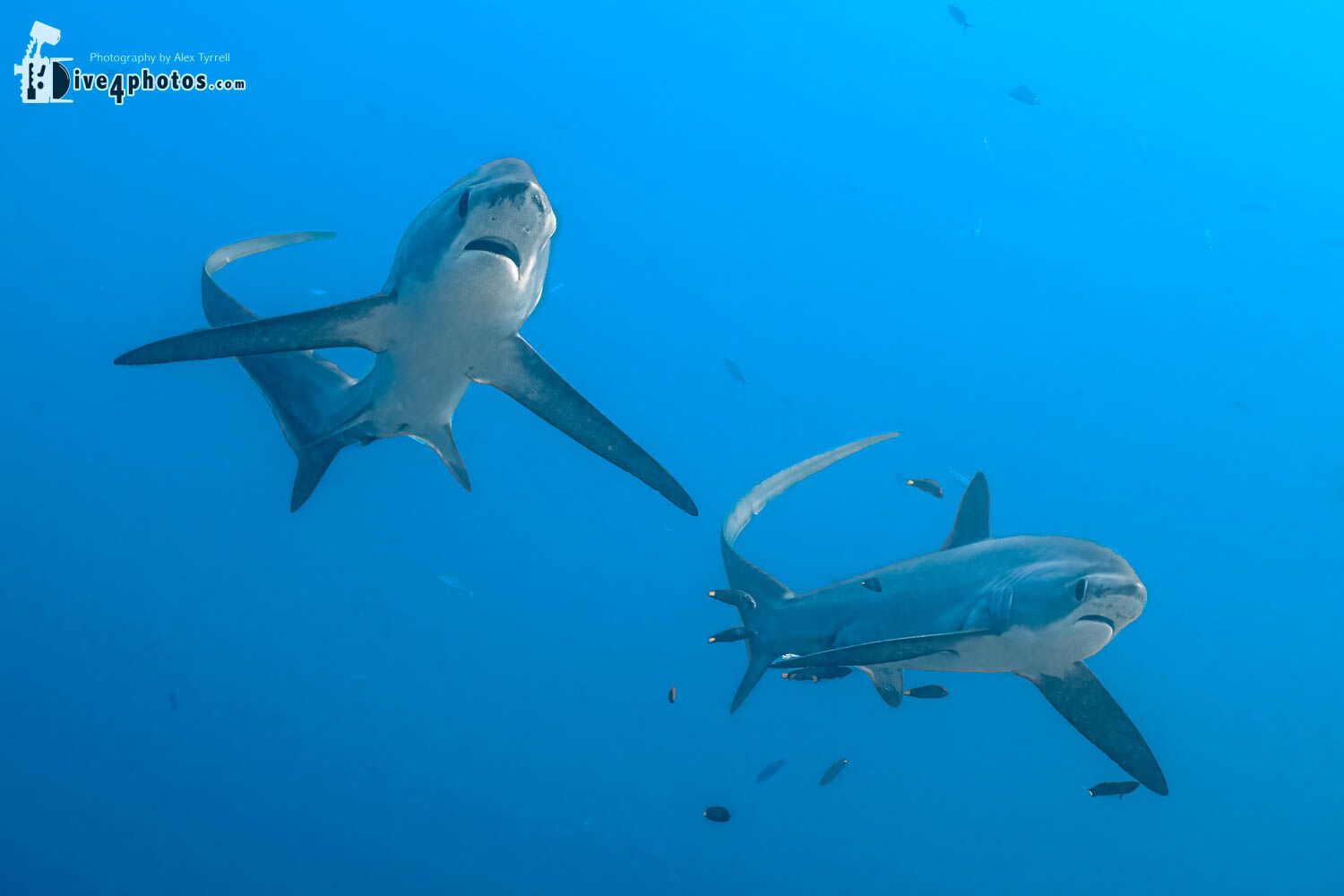
The tail is what everyone thinks about first. It is what makes threshers instantly recognisable. It can grow as long as the rest of the shark, sometimes longer. On a fully grown pelagic thresher, the tail alone can measure close to two metres.
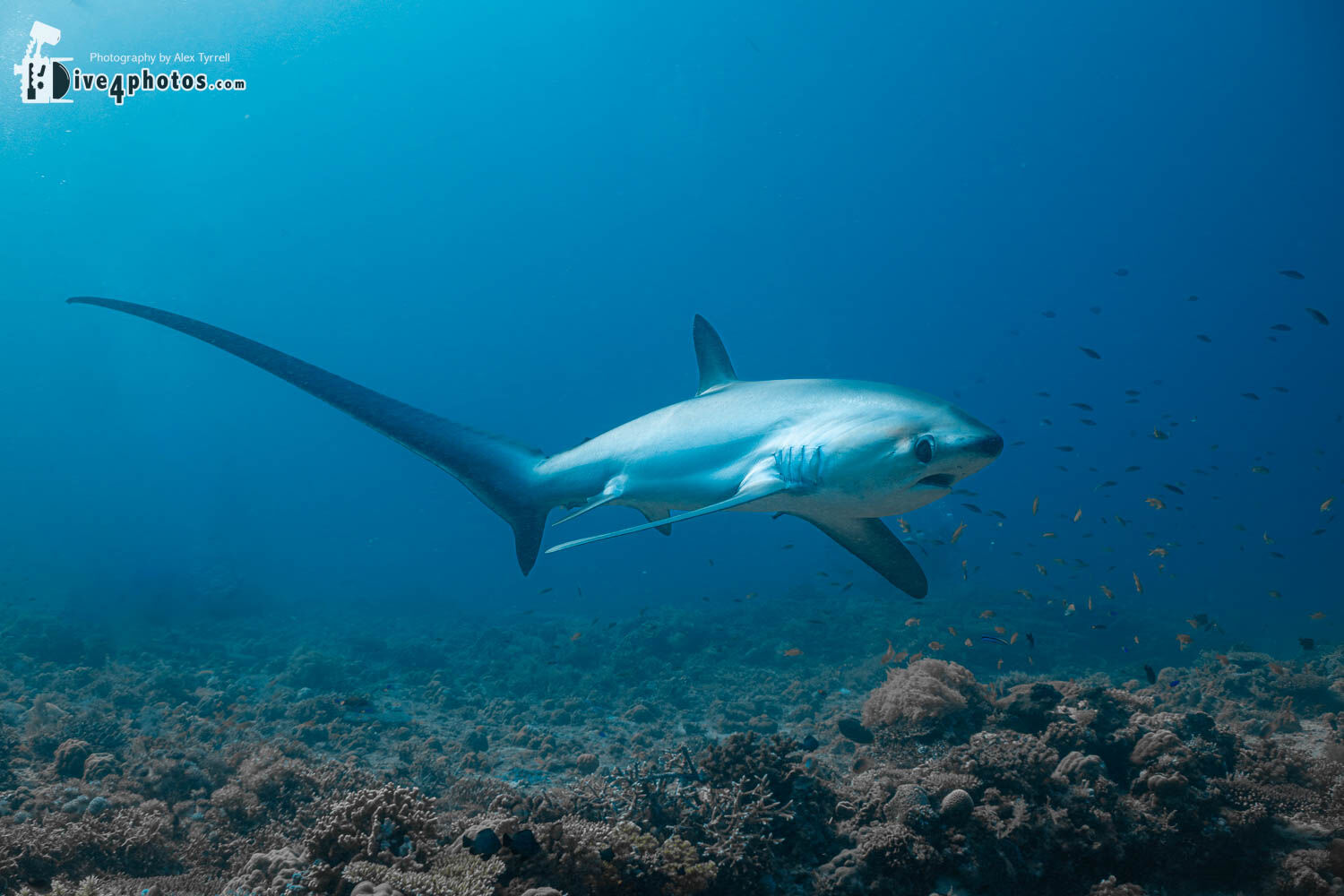
They use their tails to hunt. The shark slaps schooling fish at high speed and feeds on whatever falls limp afterward. Filipino fishermen and dive guides had been watching this for years before anyone caught it on film. The first underwater footage of the behaviour was finally recorded in 2010 at Pescador Island, off Moalboal in Cebu — the only other place in the Philippines where pelagic threshers are seen with any regularity, hunting schools of sardines in open water.
How the tail-slap works
The shark approaches a school of fish at speed. Just before reaching the school, it pulls into a sharp turn, lifts its body, and uses the upper lobe of its tail as a whip. The tail accelerates downward at speeds measured at over 50 kilometres per hour, with the fastest strikes approaching 80. The strike does not need to make contact with individual fish. The pressure wave alone, combined with cavitation bubbles forming in the water from the speed of the strike, is enough to stun or kill several fish at once.
The shark then swims back through the disoriented school and feeds at leisure.
The tail-slap is one of very few documented cases of a shark using a body part as a tool. Most shark species rely on speed, surprise, and bite force. Threshers have evolved an entirely different strategy: hit the school first, then eat.
The mechanics behind the strike are also unusual. The thresher’s caudal fin (the tail) has an enlarged upper lobe, which is what does the work. The lower lobe is much smaller. The body and tail muscles are arranged so the shark can essentially fold itself like a spring and unleash the upper lobe with extraordinary force.
Witnessing a tail-slap on a dive is rare. Most thresher encounters at Kimud Shoal happen at the cleaning station, where the sharks are calm and slow. The hunting takes place in open water, often at greater depths and away from reefs. But it is the same animal, the same tail, the same mechanics. The thresher cruising past at 12 metres is capable of a strike that has been compared to a bullwhip with a body attached.
Anatomy and senses
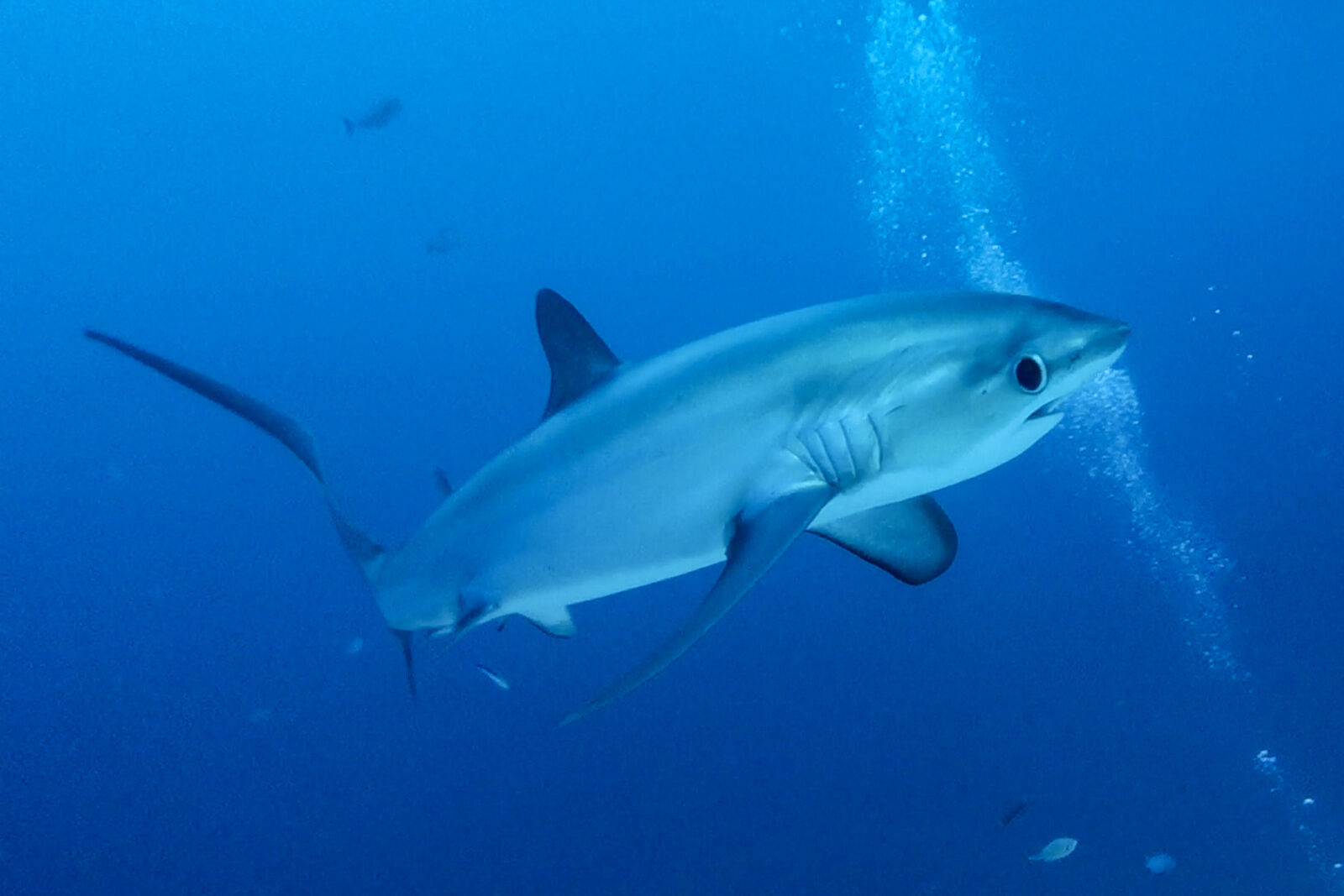
Beyond the tail, threshers have a few other features worth knowing.
- Size. Pelagic threshers reach up to about 3 metres in body length, with the tail adding another 1.5 to 2 metres on top. Total length on a large adult is around 4.5 to 5 metres.
- Weight. A large pelagic thresher weighs around 90 to 130 kilograms. Streamlined and not particularly heavy for their length, because so much of that length is tail.
- Eyes. Pelagic threshers have large eyes for their body size, an adaptation for hunting in dim light at depth. Bigeye threshers take this further with eyes that sit in deep sockets and angle upward.
- Teeth. Small and uniform, designed for gripping slippery, soft-bodied fish. Not built for tearing or crushing. A thresher’s bite is, by shark standards, surprisingly gentle.
- Lifespan. Around 20 years in the wild. Females do not reach reproductive maturity until 8 or 9 years old.
- Reproduction. Ovoviviparous. Litter sizes are small, typically two pups, gestation around nine months. This slow rate is part of why threshers are so vulnerable to overfishing.
- Pectoral fins. Long, narrow, curved, designed for efficient gliding. Tagging studies have tracked individuals crossing entire ocean basins.
- Body. Obligate ram ventilators. They have to keep swimming to push water across their gills. Even at the cleaning station, they are always moving slowly forward.
- Cold body, warm muscle. Like several other large pelagic sharks, threshers can warm specific muscle groups above the surrounding water temperature, giving them better performance at depth.
The full picture is of an animal beautifully adapted to a specific niche: open ocean, low light, fast prey, long distances. The tail is the most visible adaptation. It is far from the only one.
Where they live
Pelagic threshers occur throughout the tropical and subtropical Indo-Pacific. Confirmed populations exist around the Philippines, Indonesia, Malaysia, Vietnam, Taiwan, southern Japan, the Maldives, Hawaii, the eastern Pacific from Mexico to Peru, and parts of the Indian Ocean. In the Red Sea, pelagic threshers turn up seasonally at offshore sites like the Brothers Islands, Daedalus, and Elphinstone, mostly in the summer months.
The other two species fill out the rest of the world map. Bigeye threshers (Alopias superciliosus) are nearly cosmopolitan, found in warm and temperate oceans from the surface down to about 500 metres — including the Red Sea, where they occasionally appear at sites like Ras Mohammed. Common threshers (Alopias vulpinus) are the temperate-water species: they inhabit the Mediterranean, the eastern Atlantic up to the British Isles, the western Atlantic from New York to Florida, and parts of the Pacific including California, Australia, and New Zealand. So if you see a thresher off the UK or in cooler North Atlantic waters, it is a common, not a pelagic.
Pelagic threshers live in the open ocean rather than coastal or reef habitats. Most of their lives are spent far from land, hunting in the upper few hundred metres of water and sometimes diving deeper. Tagging data shows them regularly making vertical migrations of several hundred metres, going down during the day and rising closer to the surface at night.
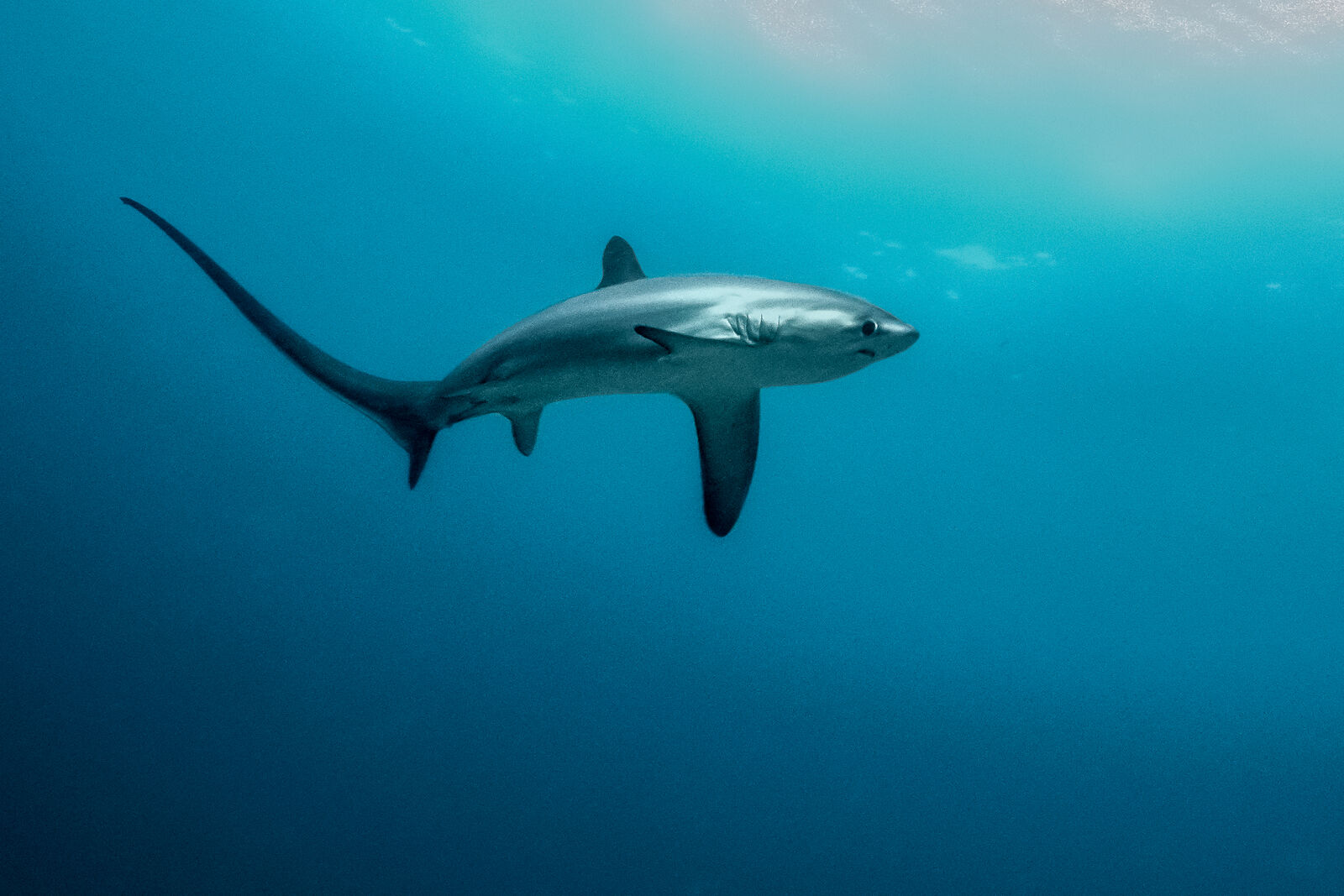
Because their habitat is mostly inaccessible to recreational divers, most people will never see a thresher in the wild. They turn up occasionally at the surface during liveaboard expeditions to remote pelagic locations, or as bycatch on tuna longlines. They are not animals divers usually plan to see.
Except in Malapascua.
The cleaning station at Kimud Shoal, off the small island of Malapascua at the northern tip of Cebu in the Philippines, is the only known place on Earth where pelagic threshers visit at recreational dive depths, daily, year-round. The cleaning station sits at around 12 to 22 metres. The sharks come up from deeper water, hover slowly while small cleaner wrasses pick parasites and dead skin off their bodies, then slip back down.
This is not a one-off. It has been happening since the dive industry first noticed it in the late 1990s, but according to local fishermen, the sharks were already there long before. Thresher Shark Divers has been operating at the site since 2004, and the sharks have been arriving every day since.
A few other locations in the Philippines occasionally see threshers, including Pescador Island off Moalboal (where they hunt sardines in open water) and parts of the Sulu Sea. The Maldives sees them on rare occasions in deep blue-water dives. None come anywhere near the consistency or accessibility of Kimud Shoal.
The Malapascua story
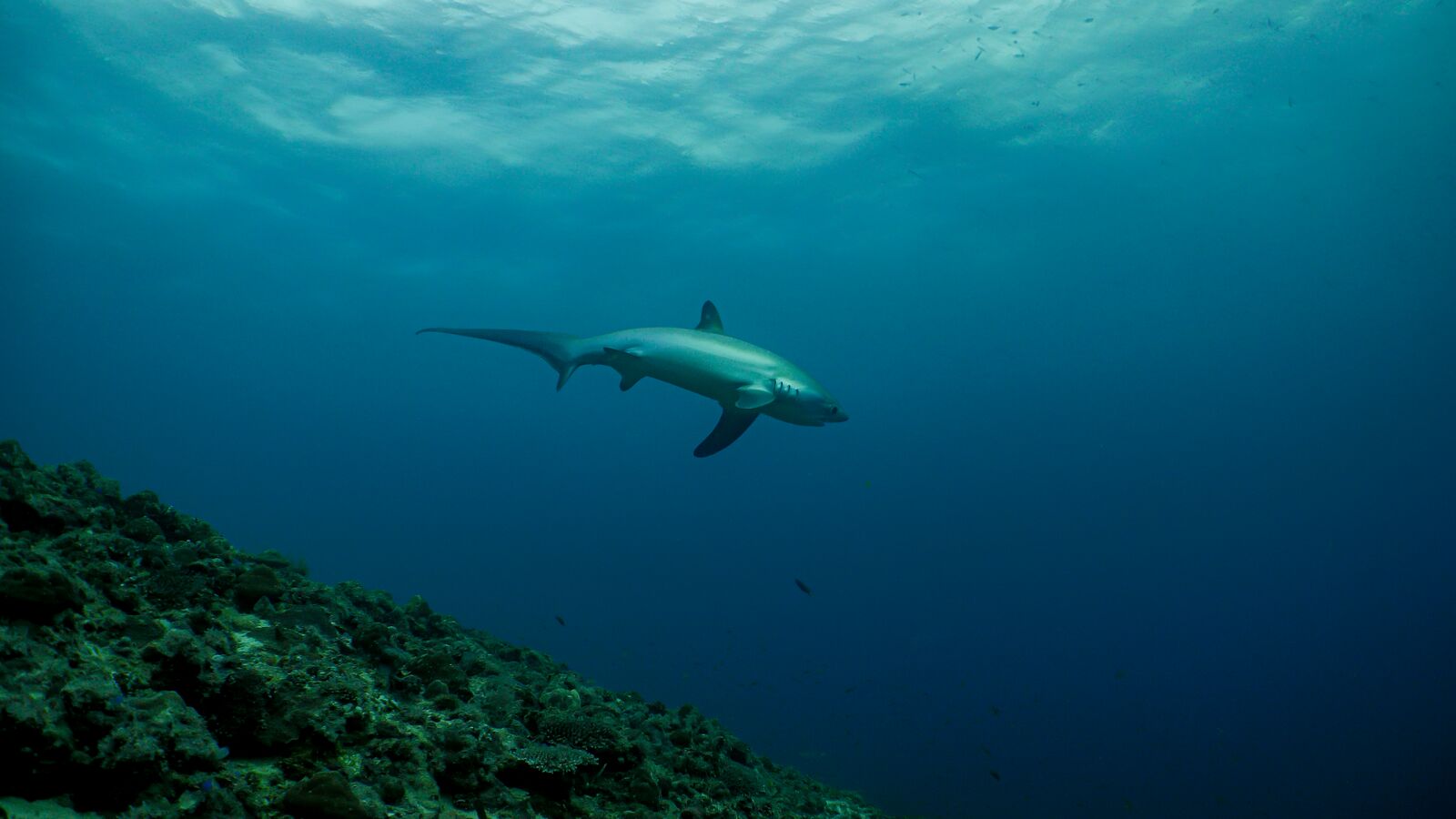
Malapascua is a small island, about 2.5 kilometres long, off the northern tip of Cebu in the central Philippines. It has no cars, no high-rise development, and a population of a few thousand. Until the 1990s, very few people outside the region had heard of it.
What put Malapascua on the dive map was a discovery made by local fishermen and a handful of early dive operators in the late 1990s and early 2000s. Pelagic thresher sharks, animals nobody expected to see at recreational depths, were appearing daily at a submerged seamount called Monad Shoal, a 20-minute boat ride from the island.
The reason turned out to be a cleaning station. Cleaner wrasses, a small species of reef fish, set up territories on the top of the seamount and feed by removing parasites and dead tissue from larger fish. For most reef fish, this is a routine arrangement. For pelagic sharks coming in from open water, it was a discovery. The threshers had learned to use the cleaning station, and individual sharks returned again and again.
Thresher Shark Divers opened in 2004 and has been recording observations at the site ever since. Over more than two decades, the dive shop has logged tens of thousands of dives at the shoals. The sharks have been a daily fixture for that entire period.
Then in 2022, something changed
The threshers shifted their primary cleaning station from Monad Shoal to a nearby seamount called Kimud Shoal. Kimud is shallower, and the sharks at Kimud come closer, stay longer, and arrive in greater numbers than they ever did at Monad. Encounters that used to require predawn descents and tight time at depth now happen comfortably in the morning, at recreational depths, with sharks visible for extended periods.
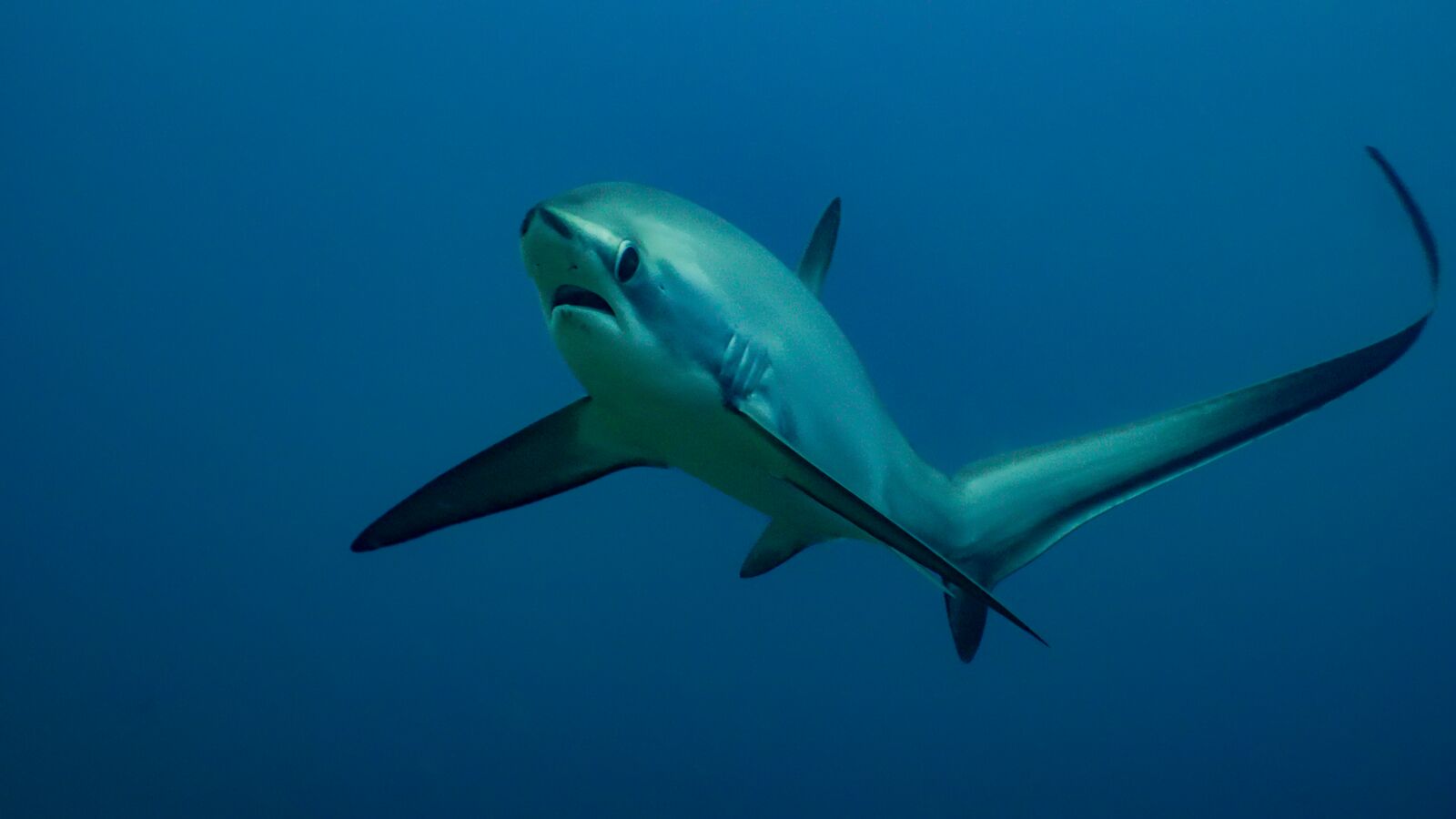
Why the move? Honest answer: nobody knows for sure. Theories include changes in cleaner wrasse populations between the two shoals, shifts in current patterns, or simply collective shark behaviour. What is clear is that Kimud has become the new centre of activity, and it has been the best era for thresher diving in Malapascua’s history.
The Kimud cleaning station now operates as the most reliable thresher shark dive on the planet. The sharks arrive throughout the morning. Group sizes are managed. The dive briefing covers behaviour rules: no chasing, no flash photography close to the sharks, stay still, and let them approach. The threshers are wild animals visiting a cleaning station, not performers, and they leave when divers behave badly. When divers keep calm, they linger, circling gracefully around the cleaning stations without a care in the world.
Over twenty years of daily observations from the same dive shop, since 2004, is, in shark research terms, a meaningful dataset. The Malapascua thresher population is the best-studied group of pelagic threshers in the world.
Are thresher sharks dangerous?
No.
There has never been a recorded fatal attack by a thresher shark on a human. There are virtually no recorded unprovoked bites of any kind. The International Shark Attack File, which has tracked shark interactions since the 1950s, lists thresher sharks as essentially absent from its records.

A few reasons:
- Thresher mouths are small. Their teeth are designed for small, soft-bodied schooling fish. A human is several orders of magnitude too large for a thresher to consider as prey.
- Thresher temperament is shy. At Kimud, divers are repeatedly told to stay still and let the sharks approach. If a thresher feels chased, it leaves. They are not aggressive. They are cautious.
- Thresher hunting happens in open water, far from divers. The tail-slap strike is dangerous to small fish. It is not a defensive behaviour and is not deployed against anything that is not prey.
Compared to almost any other shark of similar size, threshers are gentle around humans. The thousands of divers who have visited Kimud Shoal over the past two decades have produced, between them, zero injuries from the sharks themselves.
A thresher will sometimes pass within a metre of a calm, well-behaved diver and not register them as anything important. The threshers are at the cleaning station for the cleaner wrasses. The divers are guests.
Conservation
This part is less fun.
The IUCN Red List currently classifies the pelagic thresher as Endangered. The bigeye thresher is also Endangered. The common thresher is Vulnerable. All three populations are decreasing.
The main threats
- Bycatch. Pelagic longline fisheries, primarily targeting tuna and billfish, regularly catch threshers as bycatch. The long, exposed tails make them especially vulnerable to entanglement. Estimates from the Pacific suggest tens of thousands of threshers are caught as bycatch every year.
- Targeted fisheries. In some regions, threshers are targeted directly for their meat, fins, and liver oil. The fins are particularly valuable in the international shark fin trade.
- Slow reproduction. Threshers produce only a couple of pups at a time and mature slowly. A population that is overfished cannot bounce back the way faster-reproducing fish can. Once numbers drop, recovery takes decades.
- Habitat overlap with shipping and pollution. Open-ocean species are increasingly affected by ocean noise, plastic accumulation, and climate-driven changes in prey distribution.
Where progress has been made
The picture is not entirely grim. Several international agreements have moved threshers onto protected lists. CITES Appendix II protection for all three thresher species came into force in 2017, requiring international trade in thresher products to be regulated and tracked. Regional Fisheries Management Organisations have introduced retention bans in some areas.
In Malapascua, the cleaning station at Kimud Shoal is part of a marine protected area. Local enforcement, combined with active management by the dive industry, has kept the cleaning station functional through more than two decades of dive tourism. Diver behaviour rules are taken seriously, boat numbers at the site are coordinated between operators, and the sharks remain.
Research projects continue to study the Malapascua population. Photo identification, using the unique markings on individual sharks, has built up a database of returning individuals over the years. Some sharks have been identified across multiple seasons, some across a decade or more.
The most useful thing a visiting diver can do for thresher conservation is two-fold: behave well at the cleaning station, and support operators who maintain conservation standards. Sharks alive in the water are worth more, both ecologically and economically, than sharks on the deck of a longliner.
Frequently asked questions
How big do thresher sharks get?
How long do thresher sharks live?
What do thresher sharks eat?
How do thresher sharks hunt?
Where can I see a thresher shark?
Are thresher sharks dangerous?
Are thresher sharks endangered?
Why do thresher sharks come to Malapascua?
Are there hammerhead sharks in Malapascua?
What time of year is best for thresher diving in Malapascua?
How deep is the thresher shark dive?
Do I need to be an experienced diver to do the thresher dive?
How cold is the water at Kimud Shoal?
What time of day is the thresher dive?
Will I definitely see a thresher shark?
Can I take photos of the sharks?
Dive with them
Thresher Shark Divers has been running thresher dives at Malapascua’s shoals since 2004. They are a PADI 5-Star CDC, with daily departures, small groups, and more than two decades of dive logs and counting.
You’ve read the science. Now dive the dive!
Browse shark dive packages →Our network
- malapascua-diving.com — Malapascua dive guide and destination info
- thresher-shark-divers.com — book your thresher shark dives and PADI courses
- sharkdivingphilippines.com — the best shark dives across the Philippines
- philippinesdiveandtravel.com — multi-destination dive trips across the Philippines
- idc-philippines.com — PADI Instructor Development Courses
- divinginternshipsphilippines.com — scuba diving internships